Cultivating Energetic Boundaries to Create Safer Connection for Rejection Sensitive Parts
We were born wired for connection, but that doesn’t mean that it’s easy for us to meet that need, especially if we are also born with an internal makeup that can lead to social confusion and rejection sensitivity.
These experiences are deeply embedded in many Autistic, ADHD, and AuDHDers, whose brains are constantly trying to track, filter, and interpret the onslaught of sensory inputs that we’re receiving in real time, often with mixed results.
This can manifest as an acute awareness of micro-expressions, tone changes, and subtle shifts in group dynamics, which has the potential to create deep empathy and understanding, but can also trigger overwhelming anxiety about whether we've said or done something wrong.
Whether these relational misses are real or perceived, the reaction of our own protective parts can lead to cycles of shame and isolation, fueling the internalized rejection of our lonely parts who desperately long to be accepted.
Social Norms Aren’t As Intuitive As You Think
Neuronormativity is based on the flawed idea that there is a “right” way to exist, function, and connect in the world.
Without questioning these norms, we keep moving forward in complicity with them, which harms not only neurodivergent people, but everyone, as we become entrained to reject diversity and strive for uniformity.
Social norms are unfortunately deeply entrenched in these hierarchical standards, where we are expected to behave in such a way that prioritizes an avoidance of discomfort over authentic connection.
Of course, that doesn’t mean that neurodivergent people don’t make an effort. In fact, many of us make the biggest efforts of all, as protective parts feel compelled to internalize these norms to create a neurotypical mask that feels necessary for safety and connection, spending vast amounts of resources and energy to learn and apply the intricacies of social movements.
This is because missing the mark socially, even if it goes against our natural way of interpreting and communicating, has real repercussions and can lead to subtle rejection at best, and outright bullying and abuse at its worst.
When Rejection Becomes Unbearable
One of the most painful aspects of ADHD and Autism that can significantly impact relationships is Rejection Sensitive Dysphoria (RSD). The intense emotional sensitivity to perceived or actual rejection can range from mild discomfort, which is distressing in and of itself even if not dysphoric, to debilitating emotional and physical pain, an experience that is more indicative of the full RSD experience.
For someone with RSD, a friend's delayed response to a text message might trigger catastrophic thoughts about the relationship ending, while a casual comment might be interpreted as harsh criticism.
RSD doesn't exist in isolation. It's often rooted in a lifetime of real experiences of being "too much," getting in trouble, or being genuinely rejected for misunderstood behaviors, such as being distracted, impulsive, or having an atypical communication style. These accumulated experiences create what Internal Family Systems (IFS) therapy would recognize as wounded parts carrying the pain of past relational trauma.
Energetic Boundaries as a Tool for Safer Connection
One of the ways we can expand our capacity for connection is by reconnecting with our bodies to begin trusting again our ability to discern whether we are actually safe or not. Of course, this is easier said than done, and many of us need a lot of guidance and ongoing support to feel skilled enough to do so.
Nyck Walker’s book Neurodivergent Somatics in Therapy offers several helpful guidelines, and I’ve adapted one of the experiential exercises in the video below (you can also view this in my Video Resource Library along with the full transcript if that is more accessible for you):
Healing in relationship with others
We are interdependent beings, and we aren’t meant to do life alone, much less the harder moments like this one.
The beauty of unlocking embodiment practices in service of connection is realizing that it isn’t limited to how we relate to ourselves, but rather how we relate to others too, whether in community with others who are also neurodivergent or with neurotypical loved ones who want the best for us too.
Collective wisdom and change can be accessed when we’re able to be in tune with our own bodies in relationship with others, as we cultivate safer spaces and communities to slowly but surely begin sharing all parts of ourselves and recognize how relatable - and lovable - we really are.
Sabrina Bolin is a Licensed Marriage and Family Therapist and founder of Belong Within Therapy. As a multiracial (Vietnamese White), neurodivergent (AuDHD), queer (pansexual) cisgender woman, she helps highly sensitive, neurodivergent, and other marginalized and misunderstood humans relate to themselves and to the people in their lives with more compassion and greater understanding through a relational and embodied approach to IFS. Reach out today to learn more about how Sabrina can support you.
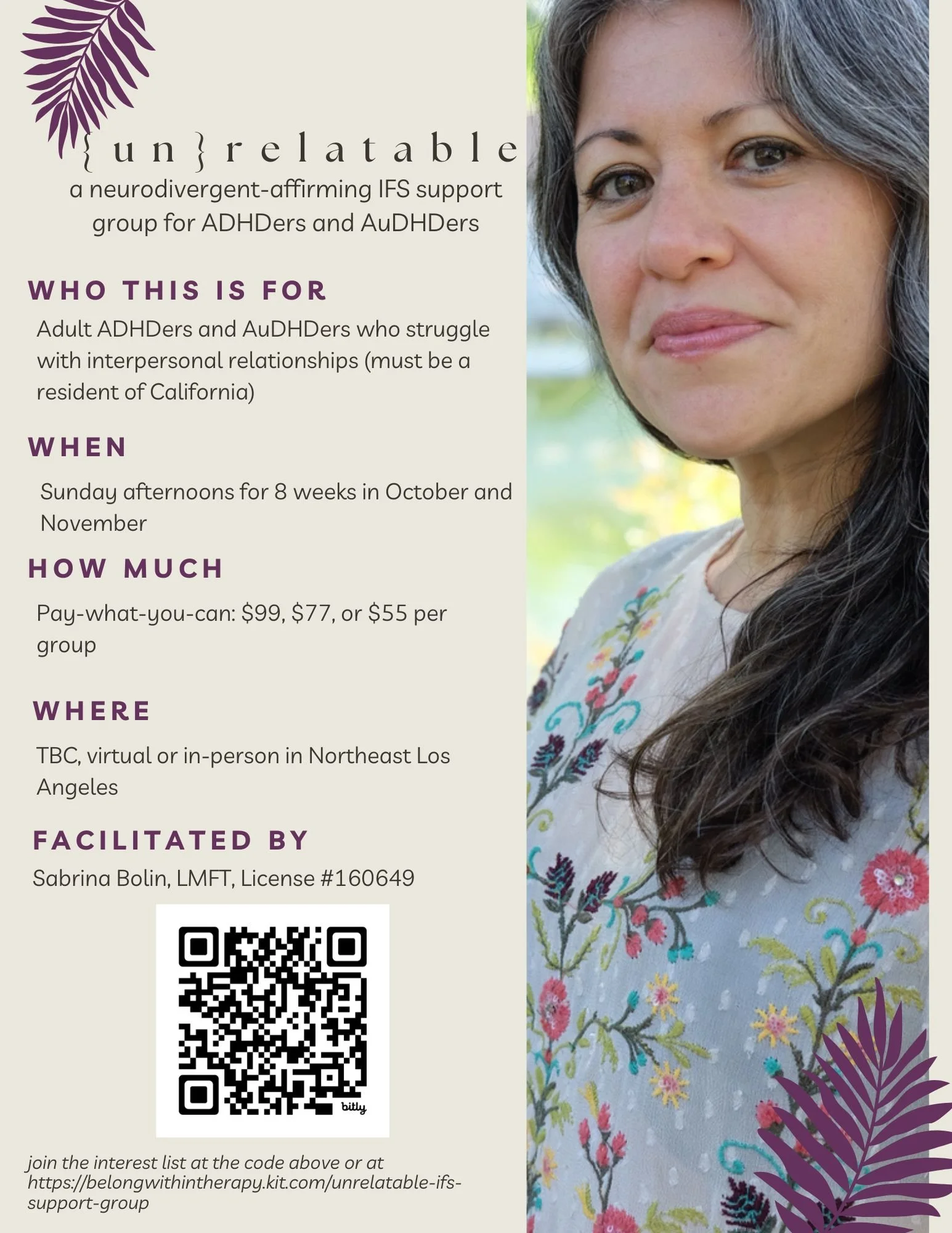
Are you an ADHDer or AuDHDer in California who is seeking support to take this deeper within a community of like-minded others?
Join the interest list for {un}relatable: a neurodivergent-affirming IFS support group for ADHDers and AuDHDers by clicking here or on the flyer below: